Flowers have always held a special place in Ayurveda. Beyond their beauty and fragrance, traditional Ayurvedic texts recognised several flowers for their distinctive qualities and therapeutic potential. Karnikara in Ayurveda represents one such lesser-known botanical treasure. Today, however, this beautiful flowering tree remains far less familiar than popular Ayurvedic flowers such as lotus, jasmine, and hibiscus.
Karnikara is commonly identified with Pterospermum acerifolium (L.) Willd., a flowering tree also known by names such as Muchkunda and Kanak Champa. Modern botanical sources place it in the family Malvaceae.
Its fragrant flowers, large leaves, and traditional medicinal significance make Karnikara an interesting addition to the Forgotten Ayurvedic Flowers series.
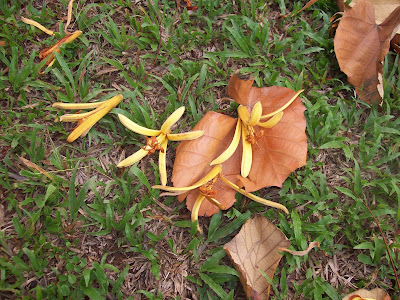
What Is Karnikara?
Karnikara refers to a traditional medicinal plant associated with Pterospermum acerifolium. The tree can grow to considerable size and produces large, fragrant flowers. Its flowers, leaves, bark, and other parts have all attracted attention in traditional medicine.
The name Karnikara appears in discussions of classical Indian plant traditions, although botanical identification can sometimes vary across regional sources. Therefore, proper botanical identification remains important before using any plant medicinally.
The plant is also popularly associated with names such as Muchkunda and Kanak Champa.
Karnikara in Ayurveda
Traditional Ayurvedic descriptions give Karnikara a distinctive place among medicinal plants. Recent reviews of Pterospermum acerifolium describe its Ayurvedic properties as Tikta (bitter) and Kashaya (astringent) Rasa, with Sheeta (cooling) Virya. The same review describes it as having Kapha-Pitta-shamaka action.
These qualities help explain why traditional Ayurvedic literature associates the plant with conditions involving heat, inflammation, and certain Kapha- or Pitta-related disturbances.
In Ayurveda, understanding a plant involves more than looking at one isolated symptom. Practitioners traditionally consider Rasa, Guna, Virya, Vipaka, Dosha, the patient’s constitution, and the nature of the condition before selecting a medicinal substance.
The Beautiful Karnikara Flower
One of Karnikara’s most memorable characteristics is its fragrant flower.
The flowers have a distinctive appearance and fragrance, which has contributed to the tree’s cultural and ornamental importance. In traditional Indian plant lore, fragrant flowers often carried significance beyond medicine. They could appear in gardens, cultural practices, religious settings, and traditional preparations.
Consequently, Karnikara represents an interesting meeting point between Ayurveda, botany, culture, and traditional knowledge.
Traditional Ayurvedic Uses of Karnikara
Traditional Ayurvedic sources and modern reviews associate Pterospermum acerifolium with several therapeutic applications. These include Daha (burning sensation), Trishna (excessive thirst), Jwara (fever), Raktapitta, Prameha, Kasa (cough), and inflammatory conditions. Researchers have also described traditional actions such as pain relief and wound healing.
1. Supporting a Balanced Pitta
Because Ayurveda describes Karnikara as having a cooling nature, traditional practitioners have associated it with conditions involving excess heat.
Therefore, traditional applications have included situations characterised by burning sensations and increased thirst.
However, these traditional descriptions should not be interpreted as proof that Karnikara can independently treat a medical condition.
2. Traditional Respiratory Support
Ayurvedic literature associates Pterospermum acerifolium with Kasa, or cough. Traditional use therefore places the plant among botanicals that may support respiratory health.
Modern research has investigated the plant’s pharmacological properties, including anti-inflammatory and antimicrobial activities. Nevertheless, most available evidence remains laboratory- or experimental-based rather than strong clinical evidence in humans.
3. Supporting the Skin and Wound-Care Tradition
Traditional medicine has also valued different parts of the Karnikara tree for wound-related applications.
The Ayurvedic perspective includes the concept of Vranaropaka, or supporting wound healing. Modern experimental research has investigated the plant’s antimicrobial, antioxidant, and anti-inflammatory properties, which may help explain some of the interest surrounding its traditional application
4. Traditional Anti-Inflammatory Applications
Ayurvedic traditions have used Karnikara in contexts involving inflammation and discomfort.
Interestingly, modern experimental studies have also reported anti-inflammatory and analgesic activities associated with Pterospermum acerifolium. However, researchers still need more high-quality human clinical trials to determine how these findings translate into practical medical treatment.
What Does Modern Research Say?
Modern researchers have started to investigate Pterospermum acerifolium more closely.
A 2026 review reported several pharmacological activities in experimental research, including antioxidant, anti-inflammatory, analgesic, antimicrobial, antidiabetic, hepatoprotective, and cardioprotective effects. Researchers have also identified groups of phytochemicals such as flavonoids, tannins, phenolic compounds, glycosides, and sterols in the plant.
However, there is an important distinction to remember.
Laboratory or animal findings do not automatically establish clinical effectiveness in humans. More controlled human studies are necessary before researchers can confirm specific therapeutic benefits, appropriate preparations, dosages, and safety.
Karnikara and the Ayurvedic View of Doshas
Ayurveda traditionally evaluates herbs according to their effect on the three Doshas:
- Vata
- Pitta
- Kapha
Recent Ayurvedic literature describes Pterospermum acerifolium as Kapha-Pitta shamaka. Its cooling nature and bitter-astringent taste contribute to this traditional interpretation.
Still, an Ayurvedic practitioner would not automatically recommend Karnikara simply because a person has a particular Dosha imbalance. Instead, the practitioner would consider the individual’s Prakriti, Vikriti, Agni, age, strength, season, diet, and existing health concerns.
This personalised approach remains one of the central principles of Ayurveda.
Why Karnikara Became Forgotten
India has an enormous botanical heritage. Yet, over time, many traditional plants became less familiar outside specialist Ayurvedic and ethnobotanical circles.
Karnikara is a good example.
Today, people commonly recognise plants such as Ashwagandha, Tulsi, Neem, Brahmi, and Turmeric. In contrast, traditional flowering trees such as Karnikara rarely receive the same attention.
Nevertheless, renewed botanical research is bringing plants such as Pterospermum acerifolium back into scientific discussion. A 2026 review specifically highlights the plant’s classical Ayurvedic background alongside modern pharmacological research.
How to Preserve the Knowledge of Karnikara
Preserving traditional plant knowledge does not simply mean collecting old remedies.
Instead, it involves:
- Correctly identifying medicinal plants.
- Recording regional names and traditional uses.
- Preserving classical Ayurvedic knowledge.
- Protecting native plant species and their habitats.
- Encouraging responsible cultivation.
- Studying traditional claims through modern scientific research.
- Avoiding exaggerated health claims that lack evidence.
In this way, traditional knowledge can remain valuable while also meeting modern standards of safety and scientific investigation.
Karnikara: A Flower Worth Remembering
Karnikara reminds us that Ayurveda’s botanical heritage extends far beyond today’s most popular herbs.
Its fragrant flowers, distinctive botanical identity, traditional Ayurvedic properties, and growing scientific interest make Karnikara in Ayurveda a fascinating subject for anyone interested in India’s forgotten medicinal plants.
Although modern research still needs to establish many of its traditional applications through well-designed human studies, Karnikara deserves recognition as part of India’s rich medicinal and cultural plant heritage.
Perhaps that is the true purpose of remembering forgotten Ayurvedic flowers—not to turn every traditional plant into a modern cure, but to preserve the knowledge, respect the tradition, verify the evidence, and keep our botanical heritage alive.
Disclaimer
This article discusses traditional Ayurvedic knowledge for educational purposes only. It does not diagnose, treat, cure, or prevent any disease. Traditional uses of Karnikara should not be considered equivalent to clinically proven medical treatments. Scientific evidence for many traditional applications remains limited, and research findings from laboratory or animal studies cannot automatically be applied to humans. Do not consume Karnikara or use it medicinally without guidance from a qualified Ayurvedic practitioner or other appropriate healthcare professional. Pregnant or breastfeeding individuals, children, and people taking prescription medicines should seek professional advice before using medicinal herbs.

Hello!!
I’m Dr. Malini Bhat MD (Ayu); an Ayurvedic Doctor and a health blogger. Follow me on social media to get daily health tips which you can easily adapt to a healthy lifestyle.