Among the medicinal trees described in Ayurveda, Nimba in Ayurveda occupies a particularly interesting position. Known today as Neem, Nimba refers botanically to Azadirachta indica A.Juss., a member of the Meliaceae family. Although modern wellness culture often reduces Neem to a simple “detox” or “skin-cleansing” herb, classical Ayurveda presents a much more sophisticated picture. Nimba has a distinctly bitter profile and traditionally enters therapeutic reasoning around Pitta, Kapha, Rakta, skin disorders, inflammation, and krimi.
Modern phytochemical research makes Nimba even more fascinating. Scientists have identified numerous limonoids, flavonoids, phenolic compounds, terpenoids, fatty acids, and other secondary metabolites across different parts of the plant. Researchers have also investigated these compounds for antimicrobial, anti-inflammatory, antioxidant, metabolic, insecticidal, and other biological activities. However, laboratory activity does not automatically translate into clinical effectiveness, so Nimba deserves a balanced scientific interpretation rather than exaggerated claims.
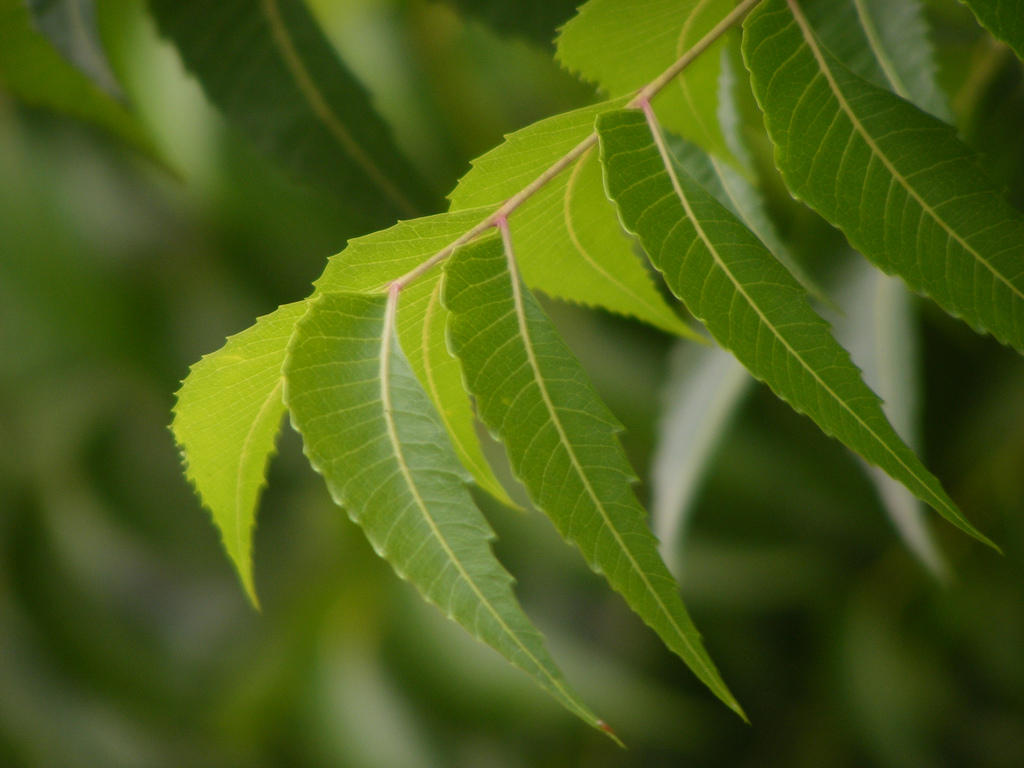
Nimba: Botanical Identity
The accepted botanical name is Azadirachta indica A.Juss. It belongs to the family Meliaceae and the order Sapindales. Kew’s Plants of the World Online recognizes Azadirachta indica as the accepted species. Its native distribution extends from Assam through parts of South and Southeast Asia, while cultivation has spread Neem to many tropical and subtropical regions.
Nimba is generally an evergreen tree with a spreading crown and rough, fissured bark. Its compound leaves contain numerous serrated leaflets. The tree produces small, fragrant white flowers followed by yellowish, ellipsoid fruits.
This botanical versatility partly explains why traditional systems developed uses for several parts of the tree rather than relying on a single preparation.
Major parts used traditionally
Ayurvedic and traditional practices have used:
- Leaves
- Bark
- Flowers
- Fruits
- Seeds
- Seed oil
- Tender twigs
- Root in selected traditional applications
Importantly, these parts do not have identical chemical compositions. Therefore, saying simply that “Neem contains one active ingredient” oversimplifies the pharmacology of the plant.
Nimba in Ayurveda: A Different Way of Understanding the Plant
Ayurveda does not classify a medicinal plant solely according to isolated molecules. Instead, it considers characteristics such as Rasa, Guna, Virya, Vipaka, and Dosha action.
Traditionally, Nimba is described predominantly as:
- Rasa: Tikta (bitter), with Kashaya (astringent) also described
- Guna: Laghu and Ruksha
- Virya: Sheeta
- Dosha tendency: Traditionally associated with reducing Kapha and Pitta, while excessive use may aggravate Vata
This framework gives Nimba a distinctive therapeutic personality.
Its bitter taste, or Tikta Rasa, receives particular importance. In Ayurvedic reasoning, bitter substances are associated with qualities that can help reduce excessive Kapha and Pitta manifestations. The traditional connection between Nimba and Rakta, skin health, and inflammatory conditions also reflects this framework.
However, Ayurveda does not imply that every person should consume Neem regularly. The same qualities that may suit one constitution or condition can become unsuitable when used excessively.
Why Is Nimba So Bitter?
The bitterness of Neem is not merely a sensory characteristic. It reflects a chemically complex mixture of secondary metabolites.
Neem contains a particularly important group of compounds called limonoids, which belong to the broader terpenoid family. Important Neem limonoids include:
- Azadirachtin
- Nimbolide
- Nimbin
- Nimbidin
- Gedunin
- Salannin
- Azadiradione
Researchers have also identified flavonoids, phenolic compounds, tannins, sterols, fatty acids, and other phytochemicals in different parts of the plant. A recent 2026 review mapped more than 140 reported compounds from A. indica and examined their potential biological pathways.
This chemical diversity matters because a leaf extract, bark extract, seed oil, and purified compound can produce very different biological effects.
Limonoids: The Molecular Signature of Neem
One of the most scientifically interesting aspects of Nimba is its abundance of limonoids.
Limonoids are highly oxygenated derivatives related to triterpenoid chemistry. In Neem, they contribute to some of the plant’s distinctive biological properties.
Azadirachtin
Azadirachtin is perhaps the best-known Neem compound outside traditional medicine.
Interestingly, its strongest established application is not human therapeutics but insect control. Azadirachtin interferes with insect feeding, development, and reproductive processes, which explains why Neem-derived products have become important botanical insecticides. Kew also identifies azadirachtin as a powerful insect-antifeedant compound associated with the species.
Therefore, the presence of azadirachtin should not be interpreted as proof that Neem itself is a universal medicine.
Nimbolide
Nimbolide has attracted considerable laboratory research because of its reported effects on cellular signaling, oxidative stress, inflammation, and cancer-related pathways.
Researchers have investigated Neem limonoids including nimbolide, gedunin, azadirachtin, and epoxyazadiradione as potential anticancer candidates. However, much of this evidence remains preclinical, involving cell cultures or animal models rather than established human cancer treatment.
That distinction remains essential.
How Might Nimba Work Biologically?
Modern pharmacology suggests that Neem does not operate through one single pathway.
Instead, different Neem constituents may influence multiple biological processes.
1. Oxidative stress
Several Neem extracts and constituents demonstrate antioxidant activity in experimental systems.
Researchers have investigated Neem-related compounds for their ability to interact with oxidative pathways and influence cellular antioxidant defenses.
Nevertheless, an antioxidant effect observed in a laboratory assay does not automatically mean that drinking Neem juice will “remove toxins” from the human body.
2. Inflammatory signaling
Neem constituents have attracted research interest because they can influence inflammatory signaling pathways.
A recent review highlighted pathways including NF-κB, MAPK, Nrf2, and PI3K/Akt/mTOR among the molecular systems investigated in Neem research.
These pathways participate in processes such as:
- Cellular stress responses
- Inflammation
- Oxidative defense
- Cell survival
- Cellular proliferation
This helps explain why researchers continue to investigate Nimba across several areas of pharmacology.
3. Microbial activity
Neem extracts have demonstrated antimicrobial activity in numerous experimental studies.
However, antimicrobial activity in a test tube does not mean Neem can replace antibiotics or antifungal medicines in clinical infections.
The concentration, extraction method, plant part, microorganism, preparation, and route of administration all influence the result.
4. Metabolic effects
Nimba has also attracted attention for its possible effects on glucose metabolism.
Experimental research has identified Neem compounds capable of interacting with carbohydrate-digesting enzymes. For example, researchers characterized nimbidiol as an inhibitor of several intestinal carbohydrate-hydrolyzing enzymes in laboratory studies.
Researchers have also investigated Neem limonoids such as gedunin and azadiradione for inhibition of human pancreatic alpha-amylase.
These findings provide mechanistic hypotheses, but they do not establish Neem as a diabetes treatment.
What Do Human Studies Actually Show?
This is where the discussion becomes more interesting.
Neem research contains a large amount of in-vitro and animal evidence, but human clinical evidence remains much smaller.
One randomized, double-blind, placebo-controlled clinical study evaluated a standardized aqueous extract of Neem leaves and twigs in 80 people with type 2 diabetes who were already taking metformin. Over 12 weeks, researchers reported improvements in fasting glucose, post-meal glucose, HbA1c, insulin resistance, endothelial function, oxidative stress, and inflammatory markers.
Another clinical study involving people with metabolic syndrome also reported improvements in glucose-related parameters and endothelial function after 12 weeks of standardized aqueous Neem extract.
These findings are promising. Nevertheless, they involve specific standardized extracts, defined doses, and controlled research conditions.
They should not be interpreted as evidence that everyone should consume raw Neem leaves or Neem juice for blood sugar control.
Nimba and the Skin: Traditional Logic Meets Modern Research
Nimba has a long traditional association with skin-related conditions.
From an Ayurvedic perspective, this connection can be understood through its Tikta Rasa, Ruksha Guna, and Sheeta Virya, along with its traditional relationship to Pitta, Kapha, and Rakta.
Modern researchers have also investigated Neem for antimicrobial, anti-inflammatory, antioxidant, and wound-related activities.
Yet “Neem is good for skin” remains an overly broad statement.
Different skin conditions have different mechanisms. Acne, eczema, fungal infections, psoriasis, bacterial infections, and allergic dermatitis require different approaches. Furthermore, concentrated Neem preparations can irritate sensitive skin.
Therefore, traditional use provides an interesting therapeutic framework, while modern dermatology requires condition-specific evidence.
Nimba and Oral Health
Neem has an especially interesting history in oral hygiene.
Traditional tooth-cleaning practices have used Neem twigs, and modern research has examined Neem-containing mouthrinses.
A systematic review identified randomized clinical trials investigating Neem mouthrinses for plaque and gingival inflammation. However, the researchers found considerable heterogeneity among the studies and did not perform a meta-analysis.
This illustrates an important principle in herbal medicine:
Traditional use can generate valuable research questions, but clinical evidence still needs careful evaluation.
Nimba and the Ayurvedic Concept of Krimi
Classical Ayurvedic texts use the concept of Krimi to describe various organisms or pathological processes.
Nimba’s traditional association with Krimi can be viewed alongside modern research into its antimicrobial and insecticidal chemistry.
However, we should not directly equate the classical term Krimi with every modern category of parasite, bacterium, fungus, or virus.
The two frameworks developed in different intellectual contexts.
Instead, the comparison becomes useful when we ask a more precise question:
Can the biological activities traditionally associated with Nimba be investigated using modern microbiology and pharmacology?
The answer is yes—and Neem research continues to explore exactly this interface.
Nimba, Agni and Ama: An Ayurvedic Interpretation
Ayurveda frequently connects digestive health with Agni, the functional principle of digestion and metabolism.
Nimba’s bitter and light qualities have traditionally influenced how Ayurvedic practitioners consider it in states involving excessive Kapha, heaviness, or certain Pitta-associated conditions.
However, Nimba does not function as a universally suitable “Agni booster.”
Its Ruksha and Sheeta qualities may make excessive or inappropriate use unsuitable for individuals with pronounced Vata characteristics or depleted digestion.
Therefore, Ayurvedic prescribing considers:
- Prakriti
- Vikriti
- Agni
- Ama
- Season
- Dose
- Duration
- Plant part
- Preparation
- Associated herbs
This individualized approach is much more nuanced than simply recommending Neem to everyone.
Why the Plant Part Matters
One of the biggest scientific mistakes in popular Neem discussions is treating the whole tree as pharmacologically identical.
It is not.
Neem leaves
Leaves contain limonoids, flavonoids, phenolics, and other compounds. Researchers have investigated them for metabolic, antimicrobial, antioxidant, and inflammatory effects.
Neem bark
Bark contains its own distinctive chemical profile and has long-standing traditional applications.
Neem seeds
Seeds contain a lipid-rich fraction that produces Neem oil.
Neem oil
Neem oil differs considerably from an aqueous leaf extract because extraction changes which compounds become concentrated.
Therefore, saying “studies show Neem works” without specifying the plant part and extract type makes the scientific conclusion incomplete.
Nimba and Modern Systems Biology
A deeper scientific interpretation of Nimba involves moving away from the idea of a single “active ingredient.”
Neem resembles many medicinal plants in that its effects may arise from multi-component, multi-target interactions.
The 2026 ethnopharmacological review describes Neem phytochemistry as involving more than 140 identified compounds and connects reported constituents with several major signaling networks.
This makes Nimba particularly interesting for modern research areas such as:
- Network pharmacology
- Metabolomics
- Molecular docking
- Systems biology
- Pharmacokinetics
- Extract standardization
- Multi-target drug discovery
However, computational predictions still require experimental and clinical validation.
A molecule that binds strongly to a protein in a computer model does not automatically become an effective medicine in a human body.
Why Standardization Matters
Two Neem preparations can be chemically different even when both carry the label “Neem extract.”
Differences may arise from:
- Plant variety
- Geographic origin
- Soil
- Climate
- Harvesting season
- Plant age
- Plant part
- Drying conditions
- Extraction solvent
- Extraction temperature
- Storage
- Standardization methods
Consequently, researchers cannot always compare one Neem study directly with another.
This issue represents one of the major challenges facing botanical medicine research.
Nimba and Cancer Research: What We Know
Neem limonoids have generated significant interest in cancer research.
Compounds such as nimbolide, gedunin, azadiradione, and azadirachtin have demonstrated various biological activities in experimental models. Researchers have investigated effects involving proliferation, apoptosis, oxidative stress, inflammation, and signaling pathways.
However, this evidence remains largely preclinical.
Therefore, Nimba should not be presented as a proven cancer treatment or as a replacement for chemotherapy, radiotherapy, surgery, immunotherapy, or other evidence-based treatments.
Its scientific value currently lies more strongly in drug-discovery research and mechanistic investigation.
The Safety Question: Is Neem Always Safe?
No medicinal plant deserves a blanket label of “completely safe.”
Neem’s safety depends on the preparation, dose, duration, route, age of the person, medications, and individual health status.
Particular caution becomes important with concentrated extracts and Neem oil.
Because Neem may influence glucose metabolism, people taking glucose-lowering medicines should not independently add concentrated Neem preparations without professional guidance.
Similarly, medicinal use during pregnancy, breastfeeding, childhood, or in people taking multiple medications requires additional caution.
Neem oil ingestion has also been associated with toxicity, particularly in children, so Neem oil should never be casually swallowed as a home remedy.
Why “Natural” Does Not Mean “Risk-Free”
This principle deserves emphasis.
A plant can simultaneously contain:
- Therapeutically interesting compounds
- Biologically active compounds
- Potentially irritating compounds
- Compounds with dose-dependent toxicity
Pharmacology is fundamentally about dose, exposure, preparation, and biological context.
Therefore, responsible Ayurvedic use does not mean taking more of a bitter herb because it is natural.
It means selecting the appropriate substance, preparation, dose, and duration for the individual.
Nimba in Ayurveda: Traditional Knowledge Meets Modern Science
The most fascinating aspect of Nimba is the convergence between traditional observation and modern investigation.
Ayurveda identified Nimba through its sensory qualities, pharmacodynamic characteristics, and therapeutic applications.
Modern science, meanwhile, has begun dissecting the tree into:
Plant → tissue → extract → compound → molecular target → biological response → clinical outcome
These are not identical frameworks.
Yet they can complement each other.
Ayurvedic knowledge can generate hypotheses about therapeutic patterns, while pharmacology can investigate mechanisms and clinical relevance.
At the same time, modern science can challenge exaggerated traditional claims by asking whether an effect has been reproduced under controlled conditions.
That dialogue is much more valuable than simply declaring that Neem is either a “miracle herb” or an ineffective traditional remedy.
What Makes Nimba a Forgotten Tree?
Neem itself may not seem forgotten. Almost everyone recognizes the tree.
What has become forgotten is the depth of its Ayurvedic identity.
Modern conversations often reduce Nimba to:
- Neem juice
- Neem face packs
- Neem oil
- Natural pesticides
- “Detox” remedies
Yet the traditional pharmacological reasoning surrounding Nimba is much richer.
Its Rasa, Guna, Virya, Dosha action, plant parts, formulations, therapeutic indications, and contraindications form a complete medicinal framework.
Modern phytochemistry adds another layer by revealing an extraordinary chemical diversity that scientists continue to investigate.
Thus, Nimba is not merely an old household remedy.
It represents a fascinating meeting point between ethnobotany, Ayurveda, phytochemistry, pharmacology, and modern drug discovery.
The Future of Nimba Research
Future research needs to move beyond simply demonstrating that Neem extracts have “antioxidant” or “antimicrobial” activity.
More useful studies should focus on:
- Standardized extracts with clearly defined chemical fingerprints.
- Pharmacokinetic studies to determine how Neem compounds behave inside the human body.
- Dose-response studies to distinguish therapeutic concentrations from potentially harmful exposure.
- Well-designed randomized clinical trials involving clearly defined preparations.
- Drug-interaction studies, particularly for glucose-lowering, anticoagulant, immunomodulatory, and other medications.
- Toxicological studies examining long-term and high-dose exposure.
- Biomarker-based research linking traditional indications with measurable biological outcomes.
Such research could help determine which traditional applications have genuine translational potential.
Final Thoughts
Nimba in Ayurveda represents far more than the familiar Neem tree growing outside Indian homes.
From an Ayurvedic perspective, Nimba possesses a distinctive bitter, light, dry, and cooling profile that has shaped its traditional therapeutic applications. From a modern scientific perspective, Azadirachta indica contains a remarkably diverse chemical repertoire, particularly limonoids and other secondary metabolites that continue to attract pharmacological research.
Human studies have produced interesting findings in areas such as metabolic health, while other research remains firmly at the laboratory or animal stage.
Therefore, the most scientifically honest view of Nimba is neither that it cures everything nor that traditional use lacks value.
Instead, Nimba deserves careful study.
It is a medicinal tree whose traditional intelligence is extensive, chemistry is complex, and clinical potential remains only partly understood.
And perhaps that is what makes Nimba one of Ayurveda’s most fascinating “forgotten” trees.
Frequently Asked Questions
1. What is Nimba in Ayurveda?
Nimba is the Ayurvedic name commonly associated with Neem, botanically identified as Azadirachta indica A.Juss. Ayurveda traditionally describes it as a predominantly bitter and cooling medicinal plant associated particularly with Kapha, Pitta, skin health, Rakta, and Krimi-related therapeutic contexts.
2. What are the major active compounds in Neem?
Neem contains numerous bioactive compounds. Important groups include limonoids such as azadirachtin, nimbolide, nimbin, nimbidin, gedunin, and azadiradione, along with flavonoids, phenolic compounds, terpenoids, and fatty acids.
3. Does scientific research prove all the traditional uses of Nimba?
No. Researchers have generated substantial laboratory and preclinical evidence, but clinical evidence varies considerably depending on the specific use, preparation, dose, and condition.
4. Can Neem lower blood sugar?
Some controlled human studies have reported improvements in glucose-related measures with specific standardized aqueous Neem extracts. However, Neem should not replace prescribed diabetes treatment, and people taking glucose-lowering medicines should seek professional advice before using concentrated Neem preparations.
5. Is Neem safe for everyone?
No. Safety depends on the preparation, dose, duration, age, health status, and other medicines. Concentrated preparations require caution, and Neem oil should not be ingested casually.
6. Why is Neem important in modern pharmacology?
Neem contains a diverse collection of biologically active compounds. Researchers are studying its limonoids and other constituents for antimicrobial, metabolic, inflammatory, antioxidant, insecticidal, and cancer-related mechanisms.
7. Is Nimba the same as Neem?
Yes. Nimba is the traditional Sanskrit/Ayurvedic name associated with Neem, whose accepted botanical name is Azadirachta indica A.Juss.
Disclaimer
This article is for educational purposes only and does not replace individualized advice from a qualified Ayurvedic practitioner or medical professional. Do not self-medicate with concentrated Neem extracts or Neem oil, especially during pregnancy, breastfeeding, childhood, or while taking medicines.

Hello!!
I’m Dr. Malini Bhat MD (Ayu); an Ayurvedic Doctor and a health blogger. Follow me on social media to get daily health tips which you can easily adapt to a healthy lifestyle.