Parijata, also known as Nyctanthes arbor-tristis, is one of Ayurveda’s cherished flowering plants. Although its delicate white flowers often fall to the ground before sunrise, this fragrant tree has a long history in traditional Indian medicine. Ayurveda uses different parts of Parijata, including its leaves, flowers, bark, and seeds, in traditional preparations.
Today, many people know Parijata mainly for its beautiful flowers and spiritual significance. However, its traditional medicinal value deserves equal attention. In Ayurveda, practitioners have traditionally explored Parijata for supporting respiratory health, digestion, joint comfort, and overall balance.
What Is Parijata?
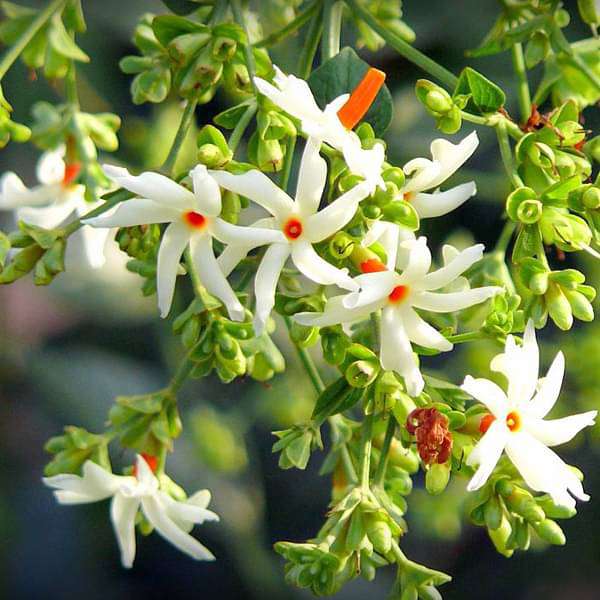
Parijata (Nyctanthes arbor-tristis) belongs to the Oleaceae family. In English, people commonly call it the night-flowering jasmine or coral jasmine.
Interestingly, the flowers bloom at night and usually drop by morning. Each flower has small white petals surrounding a bright orange-red centre. Because of this unusual flowering pattern, Parijata has earned a special place in Indian culture and traditional practices.
Ayurvedic traditions particularly value the leaves and flowers. However, traditional preparations may also use the bark and seeds depending on the intended purpose.
Parijata in Ayurveda
Ayurveda considers Parijata a useful traditional medicinal plant. Its different parts show distinct qualities, and traditional practitioners select them according to the individual’s condition and constitution.
Traditionally, Parijata has been associated with Vata and Kapha management. Its bitter taste also fits into traditional Ayurvedic approaches that aim to support digestion and maintain balance.
Furthermore, traditional herbal knowledge uses Parijata in several areas of wellness, particularly when Vata or Kapha-related discomfort appears.
Traditional Uses of Parijata
Parijata has several traditional applications in Ayurveda. However, these uses come from traditional knowledge and should not replace professional medical care.
1. Supports Respiratory Wellness
Ayurvedic traditions have used Parijata leaves in preparations intended to support respiratory comfort. Traditionally, herbal preparations containing its leaves have been used when cough, congestion, or excess Kapha occurs.
Therefore, Parijata remains an interesting plant in traditional respiratory herbal practices.
2. Traditionally Used for Joint Comfort
Parijata has also gained attention for its traditional use in managing joint discomfort and stiffness.
Ayurvedic practitioners have traditionally used leaf preparations when Vata-related joint problems cause discomfort. In addition, traditional herbal applications may focus on supporting comfortable movement.
3. Supports Digestive Function
Parijata has a bitter taste, which Ayurveda often associates with digestive and metabolic support.
Traditionally, practitioners have used its leaves in herbal preparations to support digestion and manage digestive discomfort. Consequently, Parijata continues to appear in discussions of traditional Ayurvedic plant remedies.
4. Traditionally Used During Seasonal Fevers
Traditional Indian medicine has historically used Parijata preparations during certain seasonal illnesses and fevers.
However, fever can have many causes. Therefore, anyone with persistent, high, or unexplained fever should seek medical evaluation rather than relying solely on herbal remedies.
5. Supports Traditional Skin Care
Parijata also appears in traditional approaches to skin wellness. Herbal preparations made from its leaves or other plant parts have been used traditionally for certain skin concerns.
Nevertheless, people with persistent or severe skin problems should consult a qualified healthcare professional.
Parijata and Dosha Balance
From an Ayurvedic perspective, understanding dosha balance helps explain how traditional practitioners select herbs.
Vata
Parijata has traditionally been used in approaches involving Vata-related discomfort, particularly stiffness and joint concerns. Practitioners may combine it with other herbs according to the individual’s constitution.
Pitta
Because Parijata has a bitter taste, practitioners consider the overall formulation and the person’s constitution before using it for Pitta-related concerns.
Kapha
Parijata traditionally fits well into Kapha-focused herbal approaches. Its bitter nature and traditional respiratory applications make it particularly interesting when heaviness, congestion, or excess Kapha accompanies an imbalance.
What Makes Parijata Special?
Parijata stands out because of its unusual flowering cycle. Its flowers open at night and fall naturally by morning.
Moreover, the plant carries deep cultural importance in India. Many people associate Parijata with mythology, devotion, gardens, and traditional rituals.
At the same time, Ayurveda looks beyond its beauty. Traditional practitioners have valued different parts of the plant for their medicinal qualities.
Parijata Flowers and Traditional Wellness
The flowers themselves hold a special place in traditional Indian culture. Their delicate appearance and pleasant fragrance make them popular for devotional and ceremonial purposes.
Additionally, traditional herbal knowledge recognizes the plant as more than an ornamental tree. Ayurveda considers the whole plant, including its leaves, bark, seeds, and flowers, when developing traditional preparations.
Therefore, Parijata represents the connection between beauty, culture, and traditional herbal wisdom.
What Does Modern Research Say?
Modern researchers have investigated Nyctanthes arbor-tristis for its phytochemical and biological properties. Studies have explored compounds found in different parts of the plant, including flavonoids, iridoid glycosides, and other naturally occurring constituents.
Laboratory and preliminary research has examined antioxidant, antimicrobial, anti-inflammatory, and other biological activities.
However, laboratory findings do not automatically prove that an herb will produce the same effects in humans. More high-quality human research remains necessary before drawing strong clinical conclusions.
How Is Parijata Traditionally Prepared?
Traditional Ayurvedic practice may use different parts of Parijata in forms such as:
- Herbal decoctions
- Fresh leaf preparations
- Powders
- Traditional formulations
- External herbal applications
The appropriate plant part, preparation method, dosage, and duration can vary considerably.
For that reason, avoid self-prescribing Parijata simply because it is a traditional herb. A qualified Ayurvedic practitioner can determine whether it suits your constitution and health needs.
Safety and Precautions
Natural does not always mean suitable for everyone. Therefore, use Parijata carefully and preferably under professional guidance.
Pregnant or breastfeeding individuals, children, older adults, and people taking regular medications should consult a qualified healthcare professional before using medicinal preparations containing Parijata.
Also, avoid replacing prescribed treatment with Parijata or any other traditional herb.
The Forgotten Wisdom of Parijata
Parijata may look like a simple flowering tree, yet its story extends far beyond its fragrance and beauty. Ayurveda has traditionally valued this plant for its leaves, flowers, bark, and seeds.
Furthermore, its connection with Vata and Kapha-focused traditional practices makes it an interesting addition to the forgotten medicinal flowers of Ayurveda.
As modern life moves further away from traditional plant knowledge, remembering plants such as Parijata helps preserve an important part of India’s herbal heritage.
Frequently Asked Questions About Parijata
1. What is Parijata in Ayurveda?
Parijata refers to Nyctanthes arbor-tristis, commonly known as night-flowering jasmine or coral jasmine. Ayurveda has traditionally used different parts of this plant for various wellness purposes.
2. What are the traditional uses of Parijata?
Traditional Ayurveda uses Parijata in approaches involving respiratory wellness, joint comfort, digestion, seasonal fevers, and certain skin concerns.
3. Which part of Parijata does Ayurveda use?
Traditional practices use the leaves, flowers, bark, seeds, and other parts of the Parijata plant depending on the preparation and intended use.
4. Is Parijata traditionally used for joint discomfort?
Yes. Ayurvedic traditions have used Parijata, particularly its leaves, in traditional approaches to Vata-related joint stiffness and discomfort.
5. What is Parijata called in English?
Parijata is commonly known as night-flowering jasmine or coral jasmine. Its botanical name is Nyctanthes arbor-tristis.
6. Does Parijata have Ayurvedic significance?
Yes. Parijata has both medicinal and cultural significance in India. Traditional Ayurvedic practices value several parts of the plant for different purposes.
7. Can everyone use Parijata?
Not necessarily. Individual constitution, health status, medications, and dosage all matter. Therefore, consult a qualified Ayurvedic practitioner before using Parijata medicinally.
Final Thoughts
Parijata is a beautiful example of a traditional Ayurvedic flower that deserves renewed attention. Its fragrant night-blooming flowers have cultural significance, while its leaves and other plant parts have a long history in traditional herbal practices.
Although modern research continues to explore Nyctanthes arbor-tristis, traditional knowledge remains an important part of its story. By learning about Parijata, we can reconnect with the forgotten flowers and plants that once played a meaningful role in everyday Ayurvedic wisdom.
Disclaimer
The information provided in this article about Parijata and its traditional Ayurvedic uses is intended for educational and informational purposes only. It does not constitute medical advice, diagnosis, or treatment. Traditional uses mentioned here reflect Ayurvedic knowledge and do not necessarily have sufficient clinical evidence to confirm their effectiveness.
Always consult a qualified Ayurvedic practitioner or healthcare professional before using Parijata or any herbal preparation medicinally, especially if you are pregnant, breastfeeding, taking medication, or managing an existing health condition. Do not use Parijata as a substitute for prescribed medical treatment.

Hello!!
I’m Dr. Malini Bhat MD (Ayu); an Ayurvedic Doctor and a health blogger. Follow me on social media to get daily health tips which you can easily adapt to a healthy lifestyle.